How to Measure Trading Discipline (Not Just P&L) | MetriScore
P&L tells you what happened. A discipline score tells you why. Here's how to measure your trading process across 10 metrics that actually predict future performance.
So you had a green week. Nice. But let me ask you something: was it a good week, or did you just get lucky?
Most traders can't answer that question honestly. And that's a problem.
Here's the thing about P&L: it's a lagging indicator. It tells you what happened, but it doesn't tell you whether you DESERVED that outcome. You can break every rule in your playbook, revenge trade three times, enter on garbage setups... and still end the week green if the market bails you out.
Does that mean you traded well? Hell no. It means you got lucky. And luck doesn't compound.
That's why we built MetriScore.
What Is MetriScore?
MetriScore is a discipline score from 0-100 that measures HOW you're trading, not just what your results are. It looks at 10 different metrics across three categories: Performance, Process, and Readiness.
The idea is simple: if you're doing the right things consistently, the results will follow. MetriScore measures the "right things" so you can see your progress even when the P&L is noisy.
Think of it like leveling up in a video game. Your gold goes up and down constantly. You find some, you spend some, sometimes you get robbed by a random enemy. If you only looked at your gold count, you'd have no idea if you were actually getting better at the game. But your character stats (strength, defense, skill) tell a different story. Those show your real progress, regardless of how much gold you happen to have right now.
MetriScore is your character stat sheet for trading. It shows whether you're actually improving as a trader, regardless of whether the market cooperated this week.
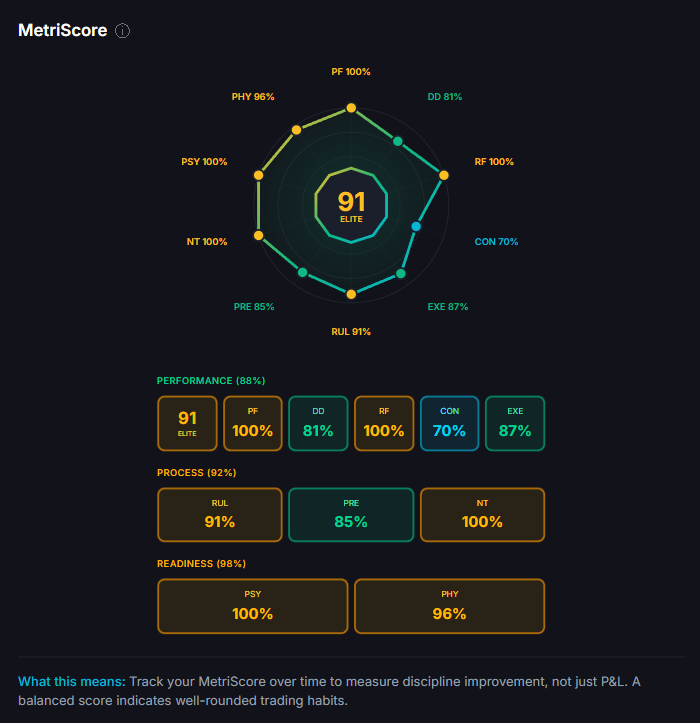 MetriScore display showing 91 Elite score with full spider web radar chart
The Three Categories
Performance (30% of your score)
This is the traditional stuff: profit factor, drawdown control, recovery factor, consistency, and execution quality. We didn't throw this out entirely because it does matter. But it's only 30% of your overall score, not 100%.
Here's what we measure:
Profit Factor (PF): Ratio of your gross profits to gross expenses. Above 1.5 is solid, above 2.0 is strong.
Drawdown Control (DD): How well you limit red streaks and protect capital. The best traders don't just make money. They manage the downside.
Recovery Factor (RF): How efficiently you recover from drawdowns. Do you dig out of holes, or do they spiral?
Consistency (CON): How steady are your returns? Wild swings in daily P&L suggest inconsistent execution, even if you're net profitable.
Execution (EXE): Quality of your entries and exits. Are you getting in at good prices? Managing trades well?
Process (25% of your score)
This is where most trading journals completely fail, and where MetriScore shines.
Rules (RUL): Did you follow your trading rules? Every time you break a rule, it shows up here. The data doesn't lie.
Pre-Market Prep (PRE): Did you do your homework before trading? Complete a pre-market checklist? Or did you just wing it?
Note Taking (NT): Are you documenting your trades with actual insights? Notes are where learning happens.
Readiness (45% of your score)
Yeah, you read that right. 45% of your MetriScore comes from readiness. Here's why.
Psychology (PSY): What was your mental state? Were you calm and focused, or stressed and reactive? Your emotions don't just affect your trading. They basically determine it.
Physical Readiness (PHY): Sleep and energy levels. Trading tired is handing money to the market. Simple as that.
We weight this category heavily because it's the foundation everything else sits on. Research from the Sleep Foundation shows that sleep deprivation significantly impairs judgment, emotional regulation, and decision-making under pressure. You can have the best strategy in the world, but if you're exhausted and tilted, you're going to make bad decisions. Period.
Why This Matters (With an Important Caveat)
So here's the beautiful part about tracking discipline instead of just P&L: you can see problems BEFORE they blow up your account.
But I need to be clear about something first: MetriScore assumes you have a strategy with an edge. Following rules perfectly doesn't help if your rules are garbage. Being well-rested doesn't matter if you're trading random setups with no statistical basis.
MetriScore measures discipline, not strategy quality. You still need to do the work to develop and backtest a strategy that actually works over time. What MetriScore does is help you execute that strategy consistently, which is where most traders fail.
With that said, let me show you why this matters.
Let's say your P&L this week is +$500. Looks good. But your MetriScore is 52. That's "Developing" tier, not great.
When you dig into the breakdown, you see:
- Rules: 61% (you broke your rules 4 times)
- Psychology: 45% (you were stressed or reactive on most trades)
- Physical: 58% (you traded on poor sleep twice)
That +$500 is a warning sign, not a celebration. You got away with sloppy trading this week. You probably won't next week.
Now flip it. Let's say you're -$200 for the week, but your MetriScore is 84. Strong tier.
Your breakdown shows:
- Rules: 95% (followed your plan almost perfectly)
- Psychology: 88% (stayed calm even through red trades)
- Physical: 90% (well-rested, high energy)
Here's the thing most traders don't understand: that -$200 might be perfectly fine.
No strategy wins 100% of the time. If you have a proven strategy with a 55% win rate and positive expectancy, you WILL have red weeks. That's not a bug. That's just probability doing its thing.
The question isn't "did I make money this week?" The question is "did I execute my edge correctly?" If yes, the math will work out over time. If no, you're gambling regardless of what the P&L says.
This is what I mean when I say MetriScore tells you if you're actually trading well vs. just getting lucky (or unlucky).
See the Transformation
Here's what improving your discipline actually looks like. On the left, a MetriScore of 49: collapsed spider web, major gaps in Process and Readiness. On the right, 91: full web, balanced metrics, elite execution.
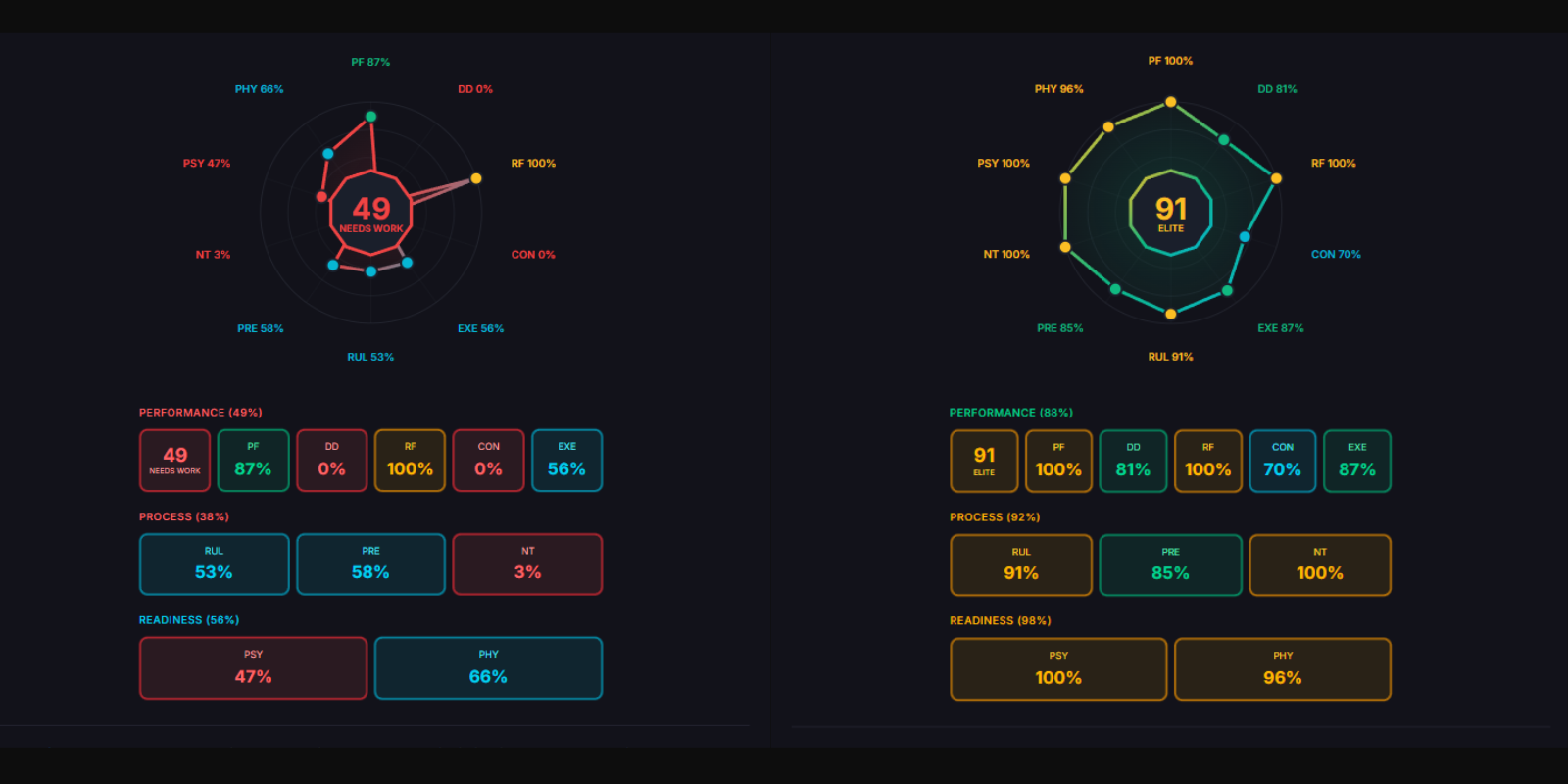 MetriScore comparison: 49 Needs Work vs 91 Elite side by side
The difference isn't talent. It's tracking, awareness, and consistent effort to improve the process.
The Probability Reality
Let me expand on this because it's important.
Say you have a strategy that wins 40% of the time with a 3:1 reward-to-risk. Sounds like a losing strategy, right? Wrong. Over hundreds of trades, you'll make money. The math works out in your favor.
But in any given week? You might take 10 trades and go 3-7. Red week. Did you do something wrong? Maybe not. You just experienced normal variance.
The problem is our brains aren't wired to think probabilistically. According to behavioral economics research by Kahneman and Tversky, we see red and think "I failed." We see green and think "I succeeded." But that's not how probability works.
A casino doesn't panic when someone wins at blackjack. They know the math is in their favor over time. They just need to keep playing.
Your job as a trader is the same: execute your edge, manage risk, and let probability do its thing. MetriScore helps you verify that you're actually doing that part, regardless of short-term results.
The Scoring Scale
MetriScore uses four tiers:
90-100: Elite - You're operating at a high level. Process is locked in.
75-89: Strong - Solid discipline. Minor areas to improve but you're doing the work.
50-74: Developing - Inconsistent. Some good habits, some leaks. Focus on process.
Below 50: Needs Work - Red flag territory. Something is off and it's showing up in your discipline.
Most traders starting out will score in the 40-60 range. That's normal. The goal isn't to be perfect on day one. It's to improve over time.
What Makes This Different
Here's what I want you to understand: MetriScore isn't just a vanity metric.
It's predictive.
A trader with a high MetriScore and mediocre P&L is in a better position than a trader with great P&L and a low MetriScore. The first trader is building sustainable habits. The second is building a ticking time bomb.
I've seen it over and over. Traders who focus on process eventually get the results. Traders who focus only on results eventually give them back.
MetriScore makes process visible. It gives you something to improve that isn't just "make more money," because honestly, that's not actionable. What IS actionable is:
- Following my rules more consistently
- Completing my pre-market prep
- Not trading when I'm tired
- Staying calm after red trades
Those are specific behaviors. Those are things you can work on. And when you improve those metrics, the overall MetriScore goes up, which means your trading is objectively getting better, regardless of what the market is doing. MetriScore is one piece of the puzzle. Here's what else to look for when picking a trading journal.
The Bottom Line
P&L is the result. MetriScore measures what creates the result.
If you only track P&L, you're looking at outcomes without understanding causes. You're celebrating wins that were potentially lucky and beating yourself up over expenses that were just variance.
MetriScore cuts through the noise. It shows you whether you're actually trading well: following your rules, showing up prepared, managing your mental state, taking care of your body.
Focus on the score, and the money follows.
See your own MetriScore at metrinote.com. 14-day free trial, no credit card required.
Ready to track what actually matters?
MetriNote is a trading journal built around psychology, not just P&L. Pre-market check-ins, mood tracking, rule accountability, and analytics that show you exactly what your habits are costing you.
Start Your 14-Day Free Trial