What to Track in Your Trading Journal Beyond P&L (2026)
Entry, exit, P&L isn't enough. Here's what the best traders actually track in their journals, from sleep and stress to rule violations and the dollar cost of mistakes.
So here's the thing about trading journals: most of them are pretty much useless.
I know that sounds harsh. But hear me out, because I spent years doing this wrong before I figured it out.
When I first started journaling my trades, I was super diligent about it. Entry price, exit price, P&L, maybe a little note about the setup. I'd log every single trade, pat myself on the back for being "disciplined," and then... nothing changed. I kept making the same mistakes. Kept revenge trading after red days. Kept ignoring my own rules when I "felt" like the trade was good.
Sound familiar?
The problem wasn't that I wasn't journaling. The problem was I was tracking the wrong stuff.
Prefer video? I walk through all of this plus a live journal walkthrough here:
The Spreadsheet Trap
Most traders treat their journal like a glorified spreadsheet. Entry, exit, P&L, maybe the instrument and direction. And look, that data isn't worthless. You need it for taxes if nothing else. But if that's ALL you're tracking, you're missing the entire point.
Think about it this way: if I told you that you were down $500 last Tuesday, what does that actually tell you? Not much. You already knew you had a red day. The question is WHY. And "the market went against me" isn't an answer. That's just describing what happened.
Here's what a basic P&L journal can't tell you:
- Were you tired when you took that trade?
- Did you break any of your rules?
- What was your emotional state before you entered?
- Was this a revenge trade after a previous red day?
- Did you actually wait for your setup, or did you force it?
That's the stuff that actually matters. That's the stuff that, when you track it consistently, starts to reveal patterns you can't see any other way.
A Quick Note on Language
Before we go further, I want to address something. You'll notice I don't use the word "loss" much. That's intentional.
In trading, we tend to frame red trades as failures. "I lost money." "I took a loss." The language implies you did something wrong.
But here's the reality: if you followed your rules, waited for your setup, and the trade didn't work out... that's not a failure. That's just the cost of doing business. It's an expense. Every business has them.
Reframing this matters because it changes how you process the trade emotionally. An "expense" is expected and manageable. A "loss" feels like something you need to fix immediately, which leads to revenge trading, which leads to actual problems.
So when I talk about red trades or expenses throughout this post, that's the mindset I'm coming from. Expenses are normal. Expenses are expected. What matters is whether you're managing them well.
What You Should Actually Be Tracking
Alright, so if P&L alone isn't enough, what should you be logging? Let me paint the picture of what a useful journal entry looks like.
1. Your Physical State
This might sound weird, but your sleep and energy levels directly impact your trading. Research from the National Institutes of Health shows that sleep deprivation significantly impairs decision-making and risk assessment. When I started tracking this, I noticed something wild: my win rate on days where I slept less than 6 hours was garbage. Like, noticeably worse. We're talking a 15-20% difference.
I never would have caught that without the data. I just thought I was having "bad days." Turns out, I was having tired days, and tired me makes terrible decisions.
Track your sleep. Track your energy. It takes two seconds and the insights are worth it. I wrote a full breakdown of the pre-market routine that changed my trading.
2. Your Mental State
Here's where most traders completely drop the ball.
Before you take a trade, how are you feeling? Calm? Focused? Or are you stressed, impatient, feeling FOMO because you missed the last move?
And after the trade, what emotions came up? Did you feel confident in your execution, or were you anxious the whole time?
This isn't woo-woo stuff. This is the 80% of trading that nobody wants to talk about because it's harder than drawing lines on a chart.
The market doesn't care about your feelings, but your trading is absolutely affected by them. If you're not tracking this, you're flying blind.
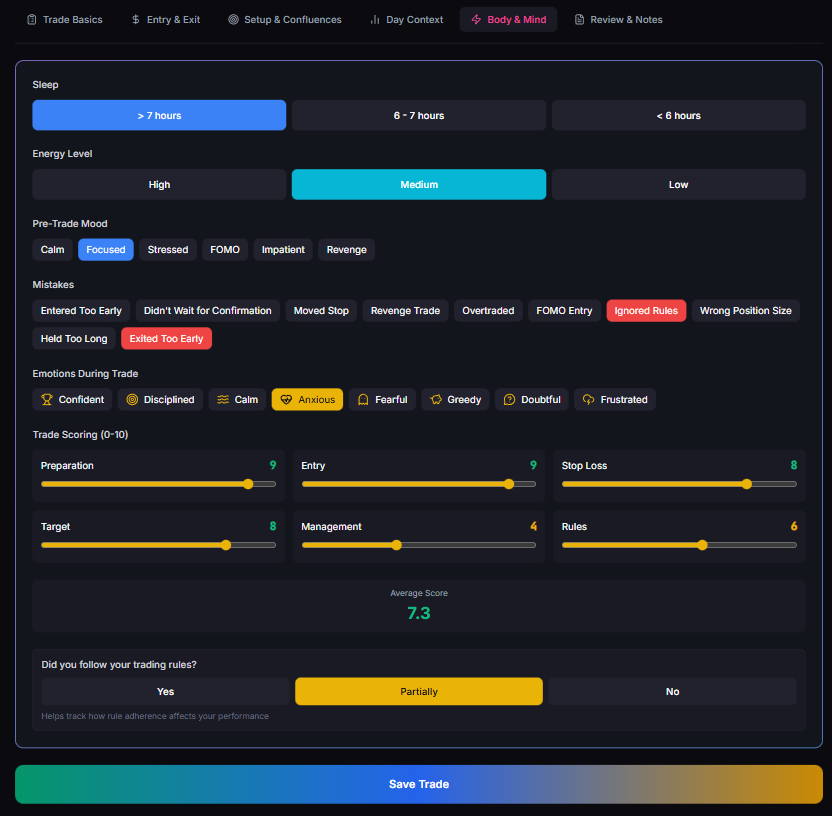 MetriNote Body and Mind check-in screen showing sleep, energy, and mood selection
3. Your Rule Adherence
Do you have trading rules? Most traders say yes. Do you actually follow them? Most traders... don't.
But here's the thing: you can't improve what you don't measure. If you're not logging when you break your rules, you have no idea how often it's happening or what it's costing you.
I'll give you an example. I had a rule: no trading before 9:35 AM. Simple enough. When I started tracking my rule breaks, I realized I was violating that rule 3-4 times per week. And my win rate on those early trades? Brutal. I was basically paying the market to ignore my own rule.
Once I saw the data, the behavior changed. Not because I suddenly had more willpower, but because I couldn't lie to myself anymore. The receipts were right there.
This is exactly why we built Accountability Mode into MetriNote. It tracks every rule violation and shows you the cost in real dollars.
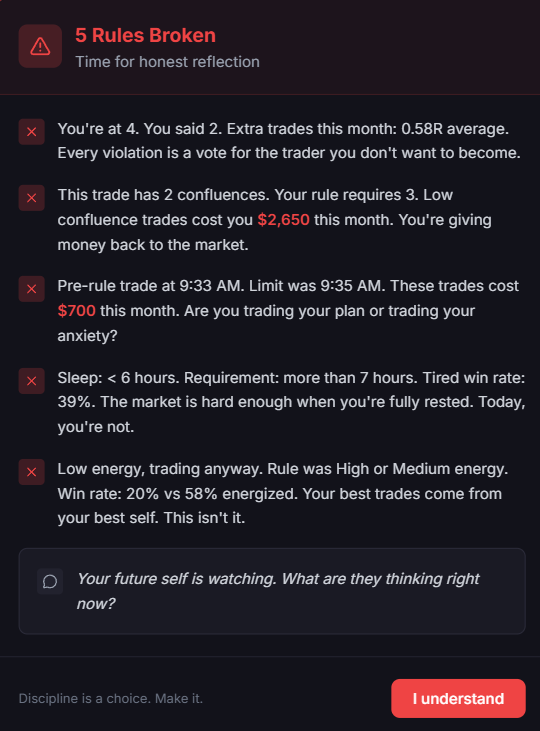 MetriNote Accountability Mode showing rule violation warnings
4. The Why Behind Each Trade
Every trade you take should have a reason. Not "it looked good." An actual, articulable reason that connects to your strategy.
When you log this, you start to see which setups actually work for you and which ones you should probably stop taking. Maybe your A+ setups have a 60% win rate, but those "I just had a feeling" trades are sitting at 27%.
That's valuable information. That's the data that actually helps you improve.
The Pattern Recognition Problem
So here's what happens when you track all this stuff consistently: patterns emerge.
You start to notice that your revenge trades (the ones you take after a red day, trying to make it back) are almost always expenses. You see that your afternoon trades underperform your morning trades. You realize that when you're feeling impatient, you tend to enter early and get stopped out.
These patterns were always there. You just couldn't see them because you weren't tracking the right things.
And once you see them? You can actually do something about them. You can build rules around your weaknesses. You can recognize when you're in a bad state and step away. You can stop doing the things that are costing you money.
Think of it like leveling up in a game. You can't optimize your character if you don't know your stats. That's why a discipline score matters more than your win rate. A trading journal that tracks psychology is your stat sheet. It shows you exactly where you're strong and where you're getting wrecked.
That's what a trading journal is supposed to do. Not just record what happened, but help you understand WHY it happened so you can break the cycle.
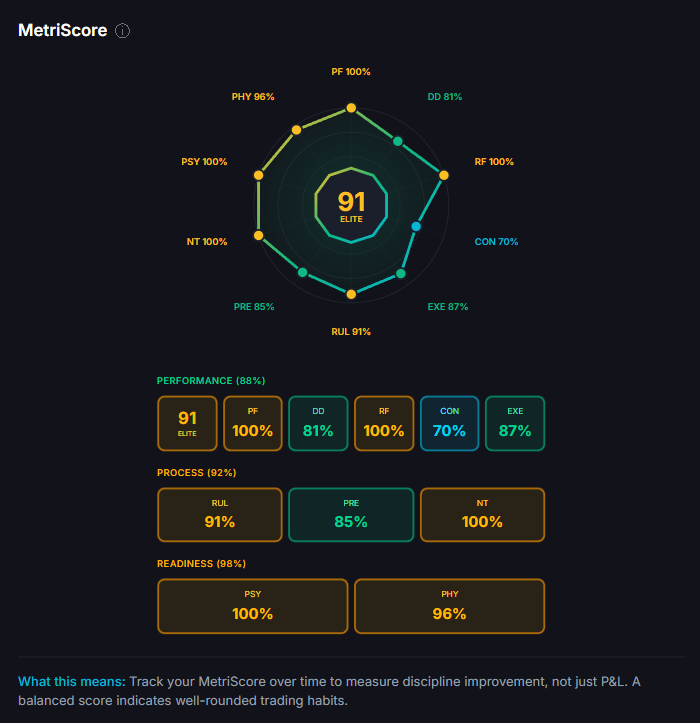 MetriScore spider web radar chart showing balanced performance across all 10 metrics
The Consistency Factor
Let me be real with you for a second.
None of this works if you don't do it consistently. Logging one trade out of ten isn't going to give you useful data. You need volume. You need to capture the good days AND the bad days, the winners AND the expenses, the disciplined trades AND the ones where you completely ignored your plan.
I know it feels like extra work. Trust me, I get it. After a tough red day, the last thing you want to do is sit there and journal about it. But those are actually the MOST important entries. That's where the gold is.
The traders who figure this out are the ones who improve. The ones who skip it keep wondering why they're stuck.
What Changes When You Do This Right
Here's the beautiful part about tracking psychology alongside your trades: you stop being confused about your results.
When you have a red week, you can look back and see exactly what happened. Maybe you were stressed about something outside of trading. Maybe you broke your rules six times. Maybe you traded on four hours of sleep.
Whatever it is, you can identify it, address it, and move forward with a plan. No more "I don't know what went wrong." No more vague promises to "be more disciplined." You have specifics. You have data. You have something you can actually work with.
And when you have a green week? You can see what you did right. You can replicate it. You can build on it.
That's the difference between traders who plateau and traders who keep improving. It's not talent. It's not some secret indicator. It's self-awareness built through consistent, honest tracking.
If you're looking for a journal that handles all of this, I wrote a full guide on how to pick the right one.
The Bottom Line
Your trading journal isn't supposed to be a record of what the market did to you. It's supposed to be a mirror that shows you what YOU did, and why.
If all you're tracking is entries, exits, and P&L, you're missing the point. You're collecting data that can't actually help you change.
Start tracking your sleep. Track your mood. Track your rule breaks. Track the emotions that come up during trades. It doesn't have to be complicated. Even a few extra fields can make a massive difference.
The traders who improve aren't the ones with the best setups. They're the ones who understand themselves well enough to get out of their own way.
That's what a real trading journal is for.
Ready to track what actually matters?
MetriNote is a trading journal built around psychology, not just P&L. Pre-market check-ins, mood tracking, rule accountability, and analytics that show you exactly what your habits are costing you.
Start Your 14-Day Free Trial