How to Stop Revenge Trading (For Real This Time)
Revenge trading has probably cost you more than any bad setup ever did. Here's why you keep doing it and how to actually stop, no willpower required.
Let me guess. You've told yourself "I'm never doing that again" at least a dozen times. Maybe a hundred.
And yet here you are, searching for how to stop revenge trading. Which means it happened again. I get it. I've been there more times than I want to admit.
Here's the thing about revenge trading: knowing it's bad doesn't stop you from doing it. If it did, you would've quit the first time. The problem isn't awareness. The problem is that in the moment, revenge trading feels like the right move.
Let me break this down, because understanding WHY you do it is the first step to actually stopping.
Why Revenge Trading Feels Logical (Even Though It Isn't)
When you take an expense, your brain does something sneaky. It reframes the situation from "I spent money on a trade that didn't work" to "the market OWES me money."
Think about that for a second. The market doesn't owe you anything. It doesn't know you exist. But in the moment after a red trade, some part of your brain genuinely believes you're entitled to make that money back RIGHT NOW.
This is basic psychology. Research on loss aversion by Kahneman and Tversky shows that red trades hurt about twice as much as equivalent green trades feel good. So a $500 expense doesn't just feel like spending $500. It feels like a problem that needs to be fixed immediately.
And what's the fastest way to fix it? Take another trade. Get it back.
Except... that's not how any of this works. The next trade has nothing to do with the last one. The market doesn't know you had a red trade. Your odds aren't better just because you "deserve" a win.
Revenge trading isn't trading at all. It's gambling dressed up as trading.
The Real Cost of Revenge Trading
Here's what I want you to do. Go back through your trading journal (you are journaling, right?) and tag every trade that was a revenge trade. Be honest with yourself.
Now calculate the total P&L of those trades.
I'm guessing it's not pretty.
When I did this exercise, I found that revenge trades accounted for over 40% of my total expenses. Not 40% of my red trades. 40% of my actual dollars gone. These were trades I never should have taken, on setups I never would have traded if I was thinking clearly.
That's the thing about revenge trading. It's not just one bad trade. It's a pattern that compounds. One red trade leads to a revenge trade, which often leads to another expense, which leads to another revenge trade...
Before you know it, you've turned a manageable $200 expense into an $800 hole. And you did it to yourself.
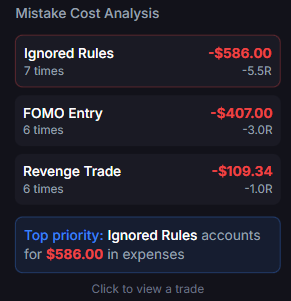 MetriNote Mistake Cost Analysis showing the dollar cost of trading mistakes
Why "Just Be More Disciplined" Doesn't Work
Alright, so if revenge trading is so obviously bad, why can't you just... stop?
Because discipline is a resource, not a character trait. And by the time you're in revenge-trading mode, you've already burned through most of it.
Think about when revenge trades happen. It's almost always:
- After an expense (or series of red trades)
- When you're frustrated or angry
- When you've already been trading for a while
- When your mental state is compromised
In other words, you're trying to exercise maximum discipline at the exact moment when you have minimum capacity for it. That's like trying to run a marathon after already running a half marathon. You've got nothing left in the tank.
This is why "I'll just be more disciplined next time" never works. You're not undisciplined. You're depleted. Research from the American Psychological Association confirms that willpower is a limited resource that gets depleted throughout the day. You can't willpower your way out of depletion.
The Hindsight Trap
While we're talking about mental traps, let's address another one that often shows up alongside revenge trading: hindsight bias.
"I shoulda held longer." "I coulda moved my stop." "I woulda been green if I just waited."
Shoulda, coulda, woulda. The three most dangerous words in a trader's vocabulary.
Here's the problem with hindsight analysis: you're evaluating decisions with information you didn't have at the time. Of course it's easy to see the "right" move after the fact. The chart is right there. But in the moment, you made the best decision you could with the information you had.
Dwelling on what you "should have" done is toxic. It makes you second-guess your process, chase moves you missed, and yes, revenge trade to "make up" for the money you "left on the table."
But here's the truth: you didn't leave anything on the table. You executed your plan. The outcome is the outcome. Learn from it if there's something to learn, then move on.
The shoulda-coulda-woulda mindset deserves its own deep dive (I'll write more about this later), but for now, just know this: if you catch yourself dwelling on what "could have been," you're setting yourself up for a revenge trade. Recognize it and walk away.
What Actually Works
So if discipline isn't the answer, what is?
Systems. Rules. Guardrails. Things that kick in BEFORE you're too far gone to think clearly.
Here's what I mean:
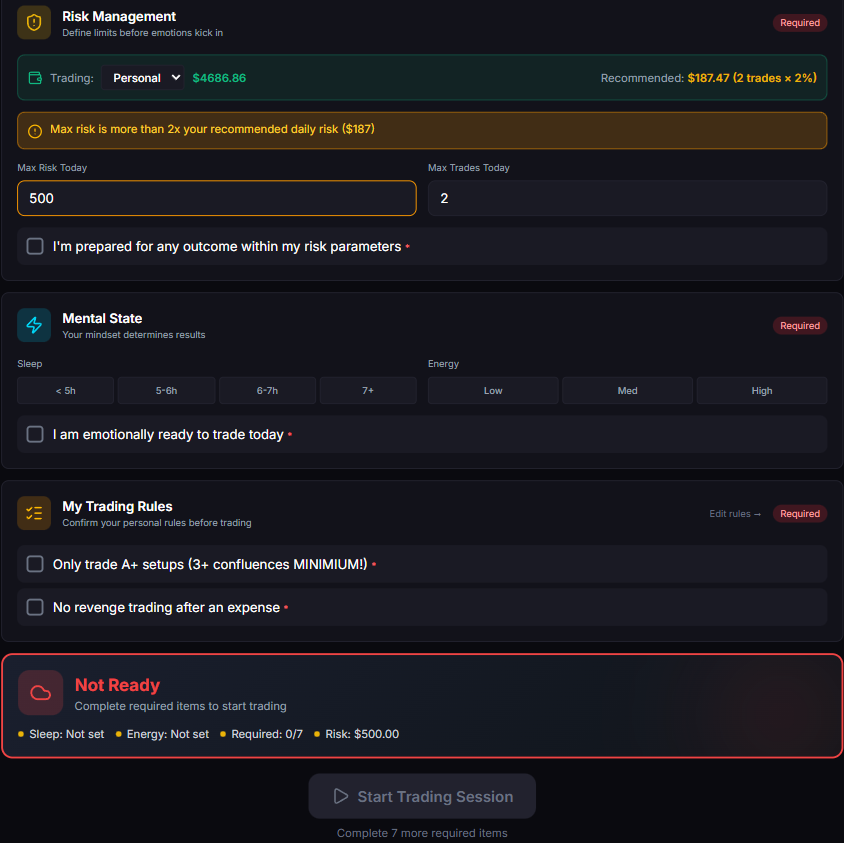 MetriNote Pre-Market Checklist ensuring you're prepared before trading
1. The Cooling Off Rule
After any red trade, you don't take another trade for X minutes. Not because you're "calming down" or whatever, but because you're creating a forced buffer between the emotional trigger and the potential revenge trade.
For me, it's 5 minutes. That's enough time for the initial emotional spike to pass. By the time those 5 minutes are up, I can usually think more clearly about whether the next setup is actually worth taking.
The key is that this rule is automatic. I don't decide in the moment whether I need a break. The break is mandatory. I had an expense, so I wait. Period.
2. The Daily Max Rule
Set a maximum number of trades per day. When you hit it, you're done. No exceptions.
This works because it removes the decision from your compromised brain. You don't have to evaluate whether you're in revenge mode. You just count: "That was trade number 3. I'm done for the day."
What's the right number? Depends on your style, but I'd start lower than you think. For most retail traders, 2-3 quality trades per day is plenty. More than that and you're almost certainly forcing things. Quality over quantity. Always.
3. The Dollar Stop Rule
Set a maximum daily drawdown. If you hit it, you stop trading for the day. Full stop.
This is your circuit breaker. It prevents a bad day from becoming a catastrophic day.
Here's the psychology behind why this works: revenge trading is about trying to get back to "even." But if you've already hit your daily max drawdown and you're forced to stop, there's no "even" to get back to today. The day is done. You'll come back tomorrow with fresh mental energy and a clean slate.
4. Track Your Revenge Trades
This is huge. In your journal, have a specific tag or checkbox for "revenge trade."
Why? Because data creates accountability.
When you have to actually mark a trade as a revenge trade, it forces you to be honest with yourself. And over time, you'll see exactly how much these trades are costing you.
There's something powerful about seeing "$2,340 spent on revenge trades this month" staring back at you. It's hard to keep making the same mistake when the receipts are right there. This is exactly what MetriScore helps you track. The right journal makes accountability automatic. Here's what to look for when choosing one.
The "Already Spent" Mindset Shift
Let me share a reframe that helped me a lot.
When you take an expense, the money is gone. It's not "owed back" to you. It's just... gone. The market took it, and you're not getting it back from this specific trade or this specific session.
Your job after an expense isn't to recover that money. Your job is to not spend MORE money unnecessarily.
Think about it this way: if someone stole $500 from you on the street, would you chase them into a dark alley? Probably not. You'd probably end up worse off. You'd accept it happened and move on.
Same thing here. The expense happened. Chasing it only risks making things worse.
When You Should Actually Take the Next Trade
Here's the thing: I'm not saying never trade after an expense. That would be silly. Red trades happen. They're part of the game.
The question is: would you take this trade if you HADN'T just had an expense?
If you see a legitimate setup that fits your criteria, and you would've taken it regardless of what happened before... that's not a revenge trade. That's just trading.
But if you're taking it primarily because you want to make back what you spent? That's revenge trading. And you need to walk away.
Be honest with yourself. You know the difference.
The Long Game
Here's the beautiful part about actually solving your revenge trading problem: the money you save is pure profit.
Every revenge trade you DON'T take is money you get to keep. You're not earning it through some brilliant strategy. You're keeping it by not giving it away.
If revenge trades are costing you $500/month (which is probably low for most traders who struggle with this), eliminating them is worth $6,000/year. That's real money. Money you keep just by walking away.
Think of it like a video game where there's a hole in your inventory bag. You keep grinding for gold, but half of it falls out through the hole. Most players would say "I need to grind harder." Smart players say "let me fix the hole first."
That's the edge most traders are missing. They're out there looking for the perfect indicator or the secret setup... meanwhile, they're bleeding money on trades they never should have taken in the first place.
Fix the leaks before you fill the bucket.
The Bottom Line
Revenge trading isn't a discipline problem. It's a systems problem.
You're not going to willpower your way out of it. You need rules that protect you from yourself. Rules that kick in automatically when you're too emotional to think straight.
Set a cooling off period after expenses. Set a maximum number of daily trades. Set a daily drawdown limit. Track your revenge trades so you can see what they're actually costing you.
The traders who make it aren't the ones who never feel the urge to revenge trade. They're the ones who have systems in place that make acting on that urge harder than walking away.
Build those systems. Your account will thank you, and so will your mental health.
Ready to track what actually matters?
MetriNote is a trading journal built around psychology, not just P&L. Pre-market check-ins, mood tracking, rule accountability, and analytics that show you exactly what your habits are costing you.
Start Your 14-Day Free Trial