How to Pick a Trading Journal That Actually Helps You Improve (2026)
I wasted 3 years on spreadsheets and bad apps before figuring out what actually matters. Here's the 9-point checklist for choosing a journal that tracks what counts.
So you're looking for a trading journal. Cool. Let me save you some time.
I spent 3 years using spreadsheets, Notion templates, random apps, and at one point a literal notebook before I figured out what actually matters in a journal. Along the way I blew about 10 accounts and lost more money than I'm comfortable admitting to my family.
This post isn't about what to track (I already wrote about that here). This is about how to pick the right tool. What features actually matter, what's marketing fluff, and what should you be paying?
Here's the checklist I wish I had before I wasted 3 years on the wrong tools.
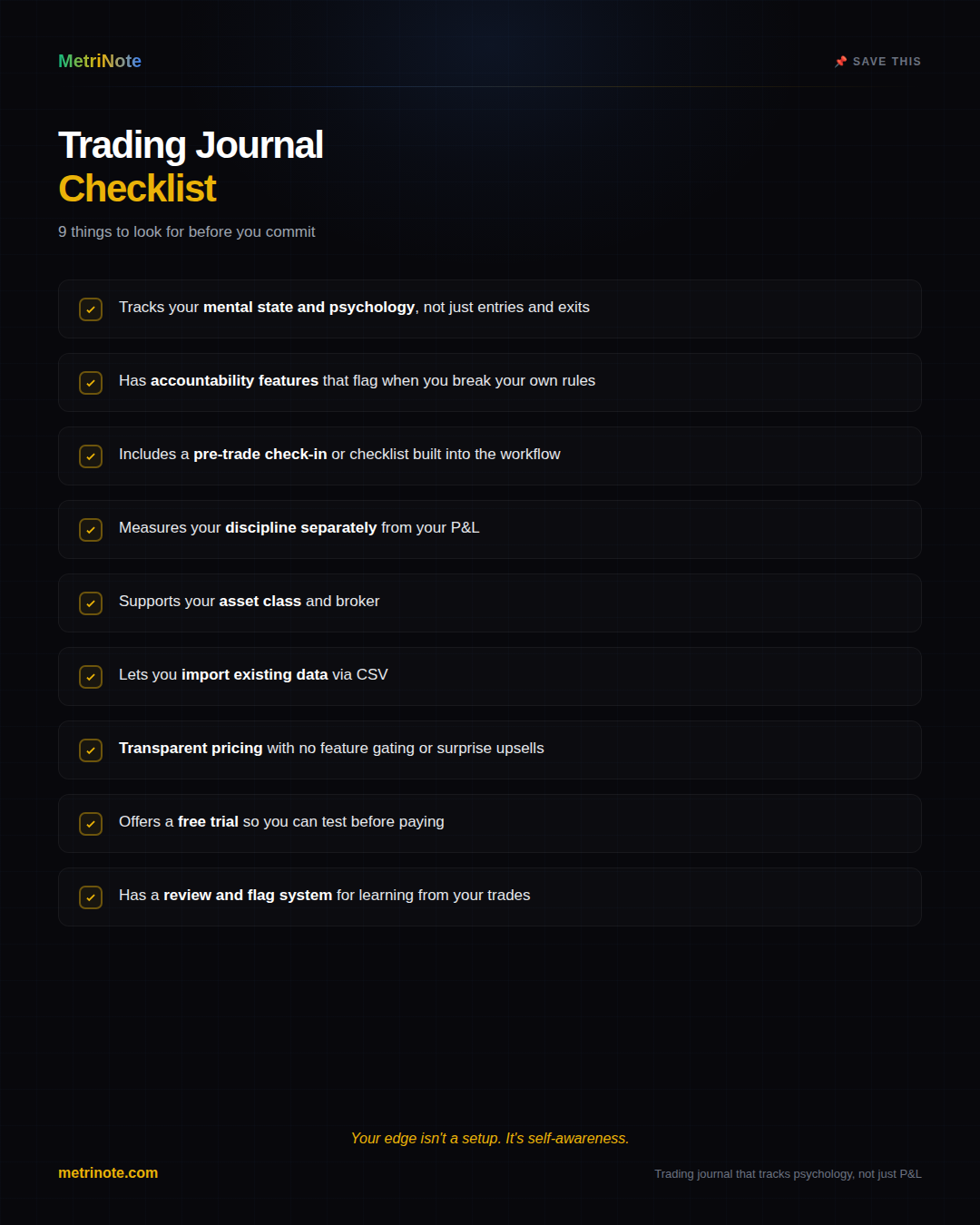 Trading journal checklist infographic showing 9 criteria to evaluate before choosing a trading journal
Let me break down why each of these matters.
It Needs to Track More Than Your Trades
I'll keep this short because I covered it in depth elsewhere. But the non-negotiable: if a trading journal doesn't track your mental state, mood, sleep, and stress alongside your trades, skip it.
A study in the Journal of Behavioral Decision Making found that emotional regulation is one of the strongest predictors of decision-making quality under uncertainty. Trading is literally decision-making under uncertainty. If your journal ignores this, it's ignoring the biggest variable in the equation.
I built my entire pre-market routine around checking in with myself BEFORE I trade, not after. Your journal should make that easy.
Most trading journal apps don't do this. They'll give you 600 statistics about your win rate by setup type, but they won't ask you how you slept. That's a gap.
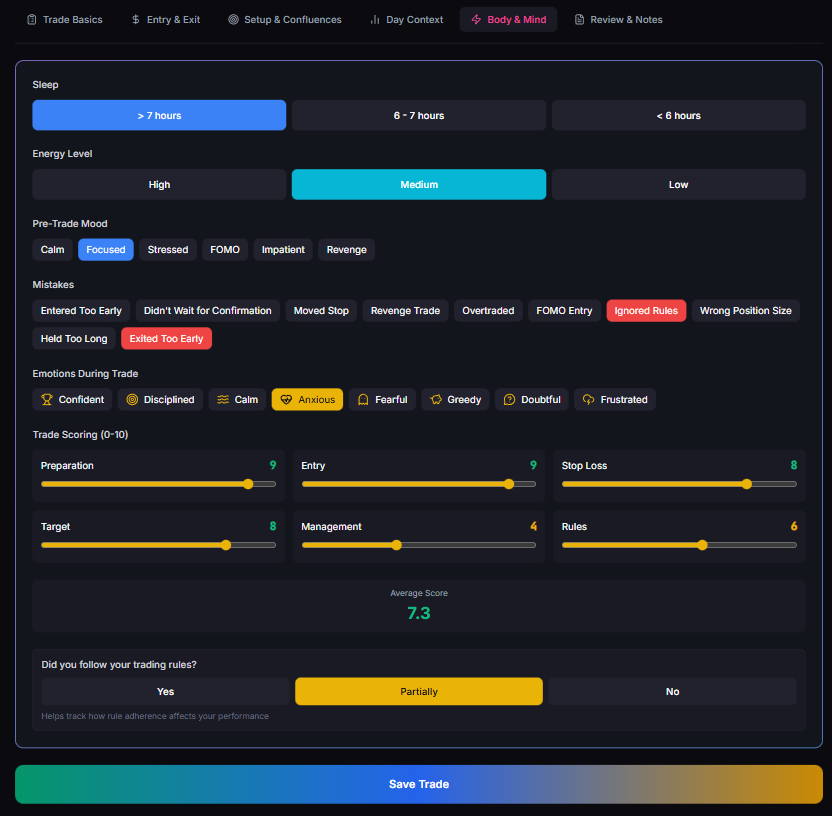 Body and Mind check-in screen in MetriNote trading journal tracking sleep, mood, stress, and energy before trading
Accountability Features Matter More Than Analytics
Hot take: most traders don't need more analytics. They need something to call them out when they break their own rules.
You already know you shouldn't take more than 3 trades a day. You already know you shouldn't trade when you're angry. You already know you should stick to your A+ setups. The problem isn't knowledge, it's follow-through.
So when you're shopping for a trading journal, ask yourself: does this tool just show me data, or does it actually help me stay disciplined? Is there anything that flags when I break a rule? Does it track the cost of my mistakes, not just my results?
This is something I looked for in every journal I tried and couldn't find anywhere. Most of them are designed to be passive record-keepers. You log your trades, they spit out charts, done. But nobody was building a journal that would say "hey, you broke your max trades rule today, and that cost you $340 this week."
That kind of feedback loop is what actually changes behavior. Not another chart showing your win rate is 52%.
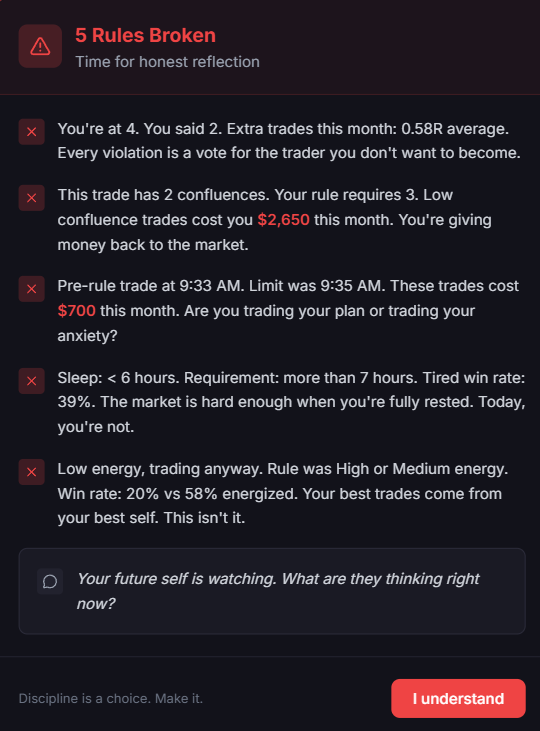 MetriNote accountability mode showing rule violation detection and dollar cost of breaking trading rules
If you want to understand what revenge trading actually costs you in real dollars, you need a journal that tracks rule violations, not just results.
A Discipline Score Beats a Win Rate
Here's something most traders don't think about when choosing a journal: how does it measure whether you're actually improving?
Win rate and P&L are lagging indicators. You can trade like garbage and still have a green week if the market bails you out. You can trade perfectly and have a red week because of normal variance. Neither of those outcomes tells you whether you're getting BETTER.
What you want is something that measures your process. Did you follow your rules? Did you stick to your plan? Were you in the right mental state? Did you respect your risk limits?
A discipline score that measures HOW you trade is more predictive than your P&L. It tells you whether your results are sustainable or whether you're just getting lucky. I built something called MetriScore around this concept if you want to see what that looks like in practice.
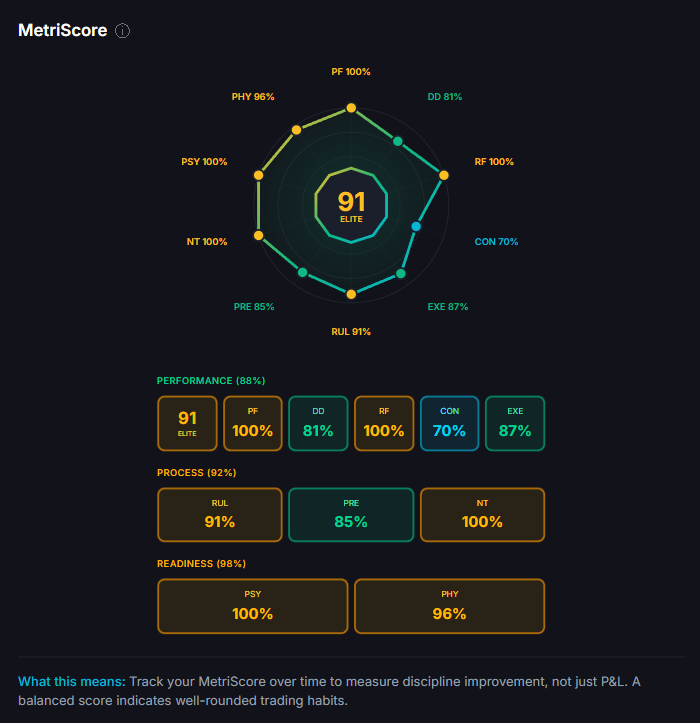 MetriScore discipline score showing performance, process, and readiness metrics in MetriNote trading journal
The point is: when you're comparing trading journal software, look for tools that measure your process, not just your outcomes. The best traders in the world have stretches of red. What separates them is that their process stays consistent through those stretches.
What Your Pre-Trade Workflow Looks Like
A good trading journal should have some kind of pre-market or pre-trade workflow. A checklist, a check-in, something that forces you to pause before you start clicking buttons.
I'm talking about a 2-minute routine. Not an hour of prep work. Something like: How'd I sleep? What's my energy? Am I bringing stress from outside of trading to the desk today? What's my plan? What are my limits?
If your journal doesn't prompt this, you're skipping it. We all know how that goes. You sit down, see a candle moving, and you're in a trade before you've even thought about whether you should be trading today.
The best trading journal apps bake this into the workflow so it becomes automatic. You open the app, you do the check-in, then you trade. Over time it becomes a habit. And that habit alone can prevent a lot of expensive mistakes.
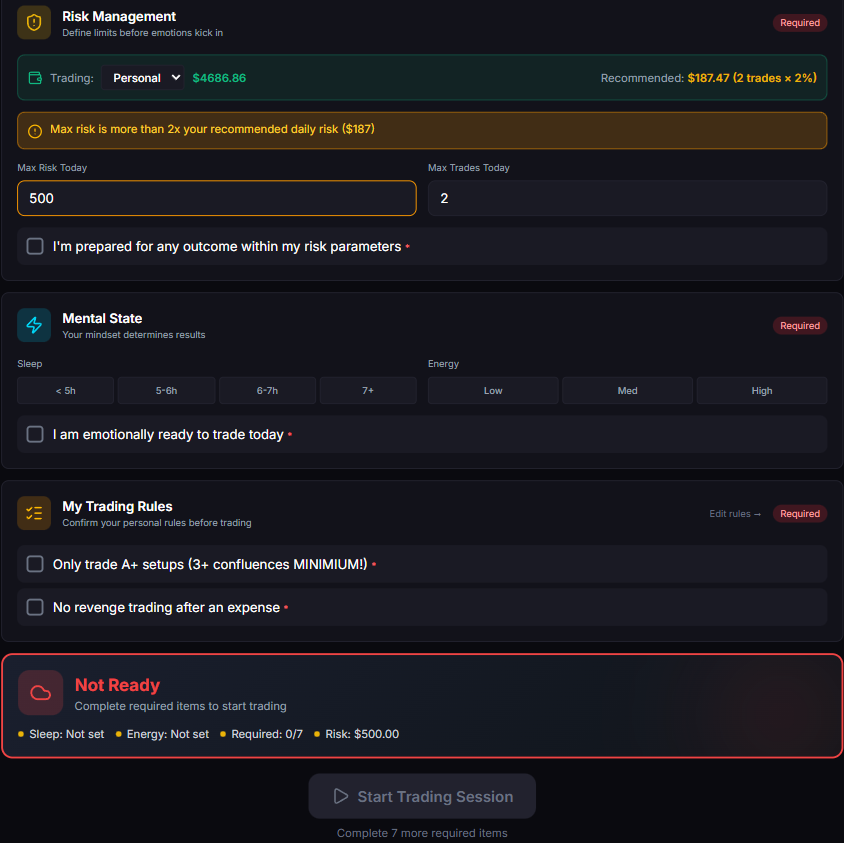 Pre-market checklist workflow in MetriNote trading journal showing daily preparation steps
Multi-Asset Support and CSV Imports
These sound basic but they trip people up. If you trade futures AND options, make sure the journal supports both. If you trade multiple instruments, make sure you can organize by ticker, asset class, or account.
Some journals are built specifically for stocks and options. They'll handle those fine but fall apart when you try to log an NQ futures contract or a forex pair. Check before you commit.
The other thing is data migration. If you're switching from another journal or from a spreadsheet, you want to know: can I bring my historical data with me? Check whether the journal supports imports from your broker or platform. Some journals support 15-20+ broker formats, others only work with a handful. If you've got 6 months of data in TradeStation or Tradovate, you don't want to re-enter all of that manually.
Pricing: What the Market Looks Like in 2026
Let me break down what the trading journal market looks like right now because pricing varies a lot.
Most journals are in the $25-50/month range. Some have tiered pricing where they gate features behind higher plans. Personally I'm not a fan of that approach. If I'm paying for a journal, I want everything included. No surprises when I click on a feature and get hit with an upgrade prompt.
Some things to watch for: does the journal offer a free trial? How long? Do they require a credit card upfront? What's the refund policy? These things matter more than you think. If a journal won't let you try it before paying, that tells you something about how confident they are in the product.
The sweet spot in 2026 seems to be $20-30/month for a full-featured journal with no feature gating. Anything above $50/month and you should be getting significant automation, AI features, or broker integrations to justify it.
And here's something most people don't think about: annual pricing. Almost every journal offers a discount if you pay yearly. If you've tried the monthly and you're sticking with it, switching to annual can save you 20-30%. Just make sure you actually like the product first.
The Review System
After you log a trade, can you go back and review it properly? Not just "look at the numbers" but actually flag trades for review, categorize them, and learn from them?
A flag system (like marking trades as A+ setup, revenge trade, FOMO entry, etc.) is incredibly useful when you're doing weekly or monthly reviews. You can filter for just your flagged trades and see patterns immediately.
The review process is where the real learning happens. The trade itself is just data. The review is where you connect the dots between your behavior and your results. If your journal doesn't make reviewing easy, you'll skip it. And if you skip reviews, you might as well not be journaling at all.
The Quick Recap
If I were picking a trading journal from scratch today: does it track psychology? Does it hold me accountable? Is there a pre-trade check-in? Does it measure discipline separately from P&L? Does it support my markets? Can I import my data? Transparent pricing? Free trial? Review system?
If it checks most of those, it's worth trying. If it only tracks entries, exits, and P&L, you can just use a spreadsheet. I built a free Google Sheet template for exactly that if you want a starting point.
Want to see what this looks like in practice? I made a full walkthrough:
How MetriNote Handles This
Everything in this article is what drove MetriNote's feature set. I built it because I couldn't find a journal that checked all these boxes after blowing 10 accounts.
Psychology tracking with Body & Mind check-ins before every session. Accountability mode that flags rule violations and calculates what they cost you in actual dollars. A discipline score called MetriScore that measures HOW you're trading across 10 metrics, so you know if your results are skill or luck. Pre-market checklists baked into the workflow. A review system with flags for learning from your trades.
14-day free trial, no credit card required. One plan, everything included, no feature gating.
But even if MetriNote isn't your thing, use the checklist above when evaluating any journal. The features that matter most aren't the ones that look impressive in a demo. They're the ones that change your actual behavior at the desk.
Your edge isn't a setup. It's self-awareness. Whatever journal you pick, make sure it helps you see yourself clearly.
Hope that helps.
Ready to track what actually matters?
MetriNote is a trading journal built around psychology, not just P&L. Pre-market check-ins, mood tracking, rule accountability, and analytics that show you exactly what your habits are costing you.
Start Your 14-Day Free Trial