The 15-Minute Pre-Market Routine That Changed My Trading
Most pre-market routines skip the most important step: checking yourself. Here's the exact routine I use every morning before opening a chart, including the mental state check-in most traders skip.
You've probably read a dozen articles about pre-market routines. Check the futures. Scan the news. Review your levels. Set your alerts.
And look, that stuff matters. But most traders fail not because they didn't check the S&P futures. They fail because they didn't check themselves.
I spent years perfecting my technical pre-market routine. I knew every economic release, every overnight gap, every key level. And I still blew up trades. Regularly.
It wasn't until I flipped the script that things changed.
The Problem With Most Pre-Market Routines
A typical trading morning looks like this:
Wake up. Coffee. Open charts. Check futures. Scan news. Mark levels. Start trading.
Sounds reasonable, right? Except there's a massive blind spot: you never once checked if YOU were ready to trade.
You're about to risk real money in one of the most psychologically demanding activities on the planet. And your preparation consists entirely of looking at external factors.
That's like an athlete showing up to a game without warming up, without checking how their body feels, without any mental preparation. Just "the field looks good, let's play."
The market doesn't care how prepared your charts are if your head isn't in the game.
Why Your Mental State Matters More Than Futures
I tracked my trades for six months, tagging each one with my mental state at entry. Not just "good" or "bad," but specific things: tired, anxious, frustrated, overconfident, calm, focused.
The results were brutal.
Trades taken when I felt "tired" or "anxious" had a win rate 23% lower than my baseline. Trades taken when I felt "calm" and "focused" performed 31% better than average.
Same setups. Same strategy. Same market. Completely different results based on my internal state.
I know "check your mental state" sounds soft, but there's hard science behind it. Research from Stanford Medicine shows that when you're stressed or anxious, the fear center of your brain (the amygdala) sends stronger signals to your prefrontal cortex, essentially hijacking the part of your brain responsible for rational decision-making. The result? Less controlled, more impulsive reactions.
You literally cannot think as clearly when your mental state is off. Your brain won't let you.
The Two Types of Pre-Market Preparation
I now think about pre-market prep in two buckets:
Internal preparation: Checking your physical state, mental state, and emotional readiness.
External preparation: Checking the market, news, levels, and setups.
Most traders do 100% external, 0% internal. The traders who consistently perform? They flip that ratio. Internal first, external second.
If your internal state is compromised, no amount of chart analysis will save you. But if your internal state is solid, you can navigate almost any market condition.
The 15-Minute Pre-Market Routine
This is the exact routine I follow every trading day. It takes about 15 minutes, and it's changed my trading more than any indicator or strategy ever did.
Minutes 1-3: Physical Check-In
Before you even look at a chart, ask yourself:
How did I sleep last night? (Be honest)
What's my energy level right now, 1-10?
Am I hungry, dehydrated, or physically uncomfortable?
Did I exercise recently, or have I been sedentary?
This isn't about being a health nut. Your body affects your brain. If you slept 4 hours, you're going to make worse decisions. That's not weakness, that's biology.
If your physical state is below a 6/10, consider trading smaller or sitting out entirely. Seriously. The market will be there tomorrow.
Minutes 4-7: Mental Check-In
Now check your headspace:
What's my overall mood right now?
Am I carrying stress from something outside of trading?
Do I feel any pressure to "make money today"?
Am I still thinking about yesterday's trades?
That last one is huge. If you're still stewing over yesterday's expense, you're not ready to trade today. You'll be revenge trading before lunch.
The goal isn't to feel perfect. It's to know where you're starting from. A trader who knows they're slightly anxious can compensate for it. A trader who doesn't realize they're anxious will blow up wondering what happened.
Minutes 8-10: Rules Review
Pull up your trading rules. Yes, every single day.
I know you think you know them. Read them anyway.
What setups am I trading today?
What's my max position size?
What's my daily loss limit?
How many trades am I allowed to take?
This sounds tedious, but it's not about memorization. It's about priming your brain. When you read your rules right before trading, they're fresh in your working memory. When you don't, they're buried under a thousand other thoughts.
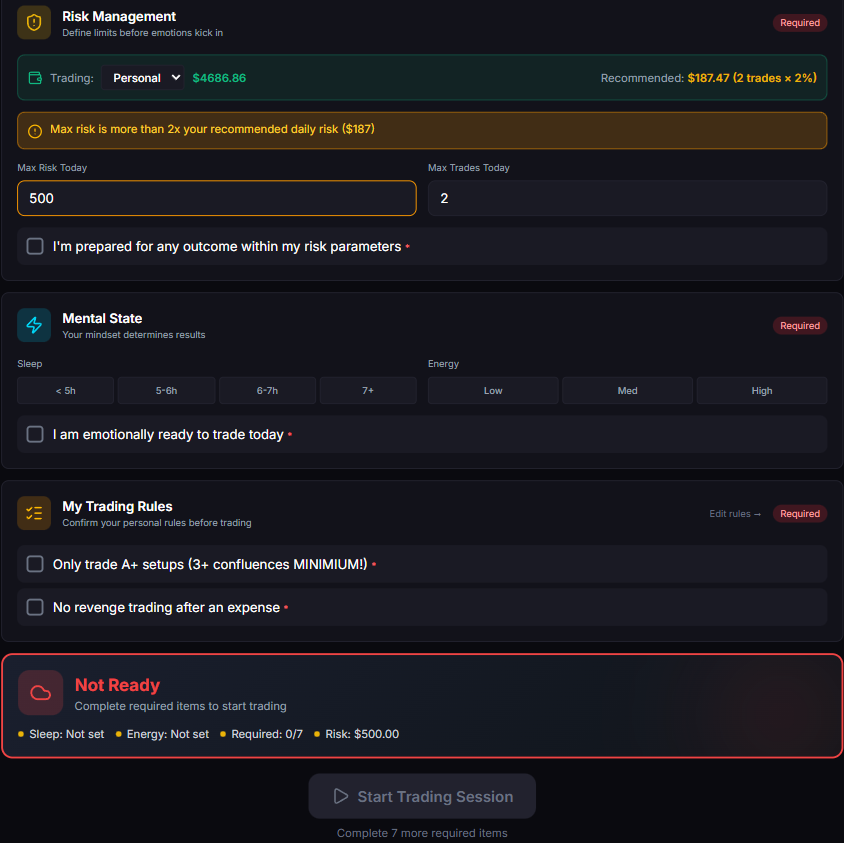 Pre-Market Checklist
Minutes 11-15+: External Prep (Finally)
NOW you can look at the market:
Check overnight action and any gaps
Review the economic calendar
Scan for any major news or catalysts
Mark your key levels for the day
Identify potential setups based on current price action
This external prep might take 10 minutes or it might take 30. It depends on what the market gives you that morning. But if you're spending longer than that, you're probably overcomplicating it.
Pre-market changes everything. You can have beautiful levels marked from the weekend, and then a surprise earnings report or geopolitical headline blows right through them overnight. That analysis you did Sunday? Potentially irrelevant by Monday at 9am.
Your weekly and monthly key levels (support, resistance) are worth marking ahead of time. Those don't change much. But your daily game plan? That needs to be built fresh each morning based on what actually happened in pre-market.
The point of doing internal prep first isn't to rush external prep. It's to make sure you're in the right headspace BEFORE you start analyzing. A tired, anxious trader looking at charts will see different things than a focused, calm trader looking at the same charts.
Why Order Matters
You might be thinking: "Can't I just check the charts first and then do the mental stuff?"
No. And here's why.
The moment you see a chart, your brain starts processing. You see a gap up and you feel excited. You see red candles and you feel nervous. Your emotional state is now influenced by external factors before you've even assessed your baseline.
By checking yourself FIRST, you get an honest read on where you're starting from. Then you can consciously decide whether that starting point is good enough for today's market conditions.
It's the difference between "I feel anxious" and "I feel anxious because the market is gapping down." The first is useful information. The second is rationalization.
The Days You Shouldn't Trade
Most trading educators won't tell you this: some days, the best trade is no trade.
If your physical check-in reveals you slept 3 hours because you were up with a sick kid... maybe don't trade.
If your mental check-in reveals you're stressed about a big meeting at work later... maybe don't trade.
If your rules review reminds you that you've already hit your weekly loss limit... definitely don't trade.
Not trading IS a trading decision. Often it's the best one you'll make all week.
The traders who last in this game aren't the ones who trade every day. They're the ones who only trade when conditions (internal AND external) are favorable.
Building the Habit
I'll be honest: this routine felt awkward at first. I'd been trading for years without it. It felt like unnecessary extra steps.
But within two weeks, I noticed something. The quality of my trades improved. Not because I found better setups, but because I was only taking trades when I was actually ready to execute properly.
The days I felt off and traded anyway? Those were almost always my red days. The days I felt off and sat out? I'd watch the market make moves I absolutely would have butchered if I'd been in.
Your trading journal will show you this pattern if you track it. The data doesn't lie.
What This Has to Do With Consistency
Every trader wants consistency. But you can't be consistent in your results if you're not consistent in your preparation.
If some days you trade well-rested and focused, and other days you trade exhausted and distracted, your results will be all over the place. Not because the market is random, but because YOU are random.
A pre-market routine that includes internal checks creates consistency in your input. And consistent input is the only way to get consistent output.
This is exactly what MetriScore measures, by the way. Not just your P&L, but the consistency of your process. Because process consistency predicts result consistency far better than any individual trade outcome.
The Bottom Line
Most pre-market routines are backwards. They focus entirely on external factors while ignoring the most important variable in your trading: you.
The traders who win consistently aren't the ones with the best chart setups or the fastest news feeds. They're the ones who show up ready to trade. Mentally. Physically. Emotionally.
That's the real edge. It's not sexy. It's not a secret indicator. It's just doing the boring work of checking yourself before you wreck yourself.
15 minutes. Every day. Internal first, external second.
Try it for two weeks. Track the difference. I think you'll be surprised. Your pre-market checklist is only as good as the tool tracking it. Here's how to pick a journal that actually supports this workflow.
The best pre-market routine isn't about preparing for the market. It's about preparing yourself.
Ready to track what actually matters?
MetriNote is a trading journal built around psychology, not just P&L. Pre-market check-ins, mood tracking, rule accountability, and analytics that show you exactly what your habits are costing you.
Start Your 14-Day Free Trial